
19 Jan 2024| By: Abdullah Hussein
Asphaltenes are the heaviest and most complex component of crude oil. They are dark in color and are often referred to as “the cholesterol of oil.” Similar to bad cholesterol in the bloodstream, asphaltenes are notorious for causing a wide range of operational problems, including:
- Formation damage
- Alteration of rock wettability
- Stabilization of emulsions and interference with phase separation
- Flow restrictions and blockages
- Damage to surface and subsurface equipment
- Induction of wax gelation and increase in oil viscosity
- Interference with produced water treatment chemicals and other production chemicals
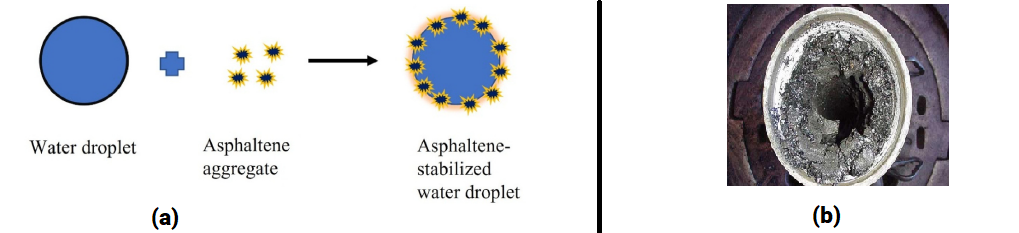
Fig.1: Examples of asphaltenes problems: (a) Emulsion stabilization by asphaltenes (source Yonguep, et al. (2022) Petroleum Research, https://doi.org/10.1016/j.ptlrs.2022.01.007) (b) Asphaltenes deposits (courtesy of baker Hughes)
Beyond these well-known issues, asphaltenes are particularly challenging because of their elusive and unpredictable behavior. This elusiveness arises from their ability to interact in multiple ways with nearly every component of the production system, including gas, oil, water, reservoir rock, and injected chemicals. Such behavior is primarily governed by their molecular structure and unique properties: they are heavy hydrocarbons, polar in nature, often carry surface charges, are sensitive to electric fields, can act as surfactants, and—most importantly—possess an extremely complex and heterogeneous composition.
Asphaltenes can be destabilized by numerous changes in production conditions, leading to aggregation and eventual deposition. To better understand this behavior, it is essential to examine their composition and structural characteristics.
Definition and Composition of Asphaltenes
In the literature, asphaltenes are commonly defined as a solubility class: the fraction of crude oil that is insoluble in n-alkanes (e.g., n-pentane or n-heptane) but soluble in aromatic solvents such as toluene. Their composition typically includes polyaromatic cores, aliphatic side chains, heteroatoms (nitrogen, oxygen, and sulfur), and trace metals such as nickel, vanadium, and iron.
Two main molecular architectures are widely used to represent asphaltenes: the continental and archipelago structures, as illustrated in Fig. 2.
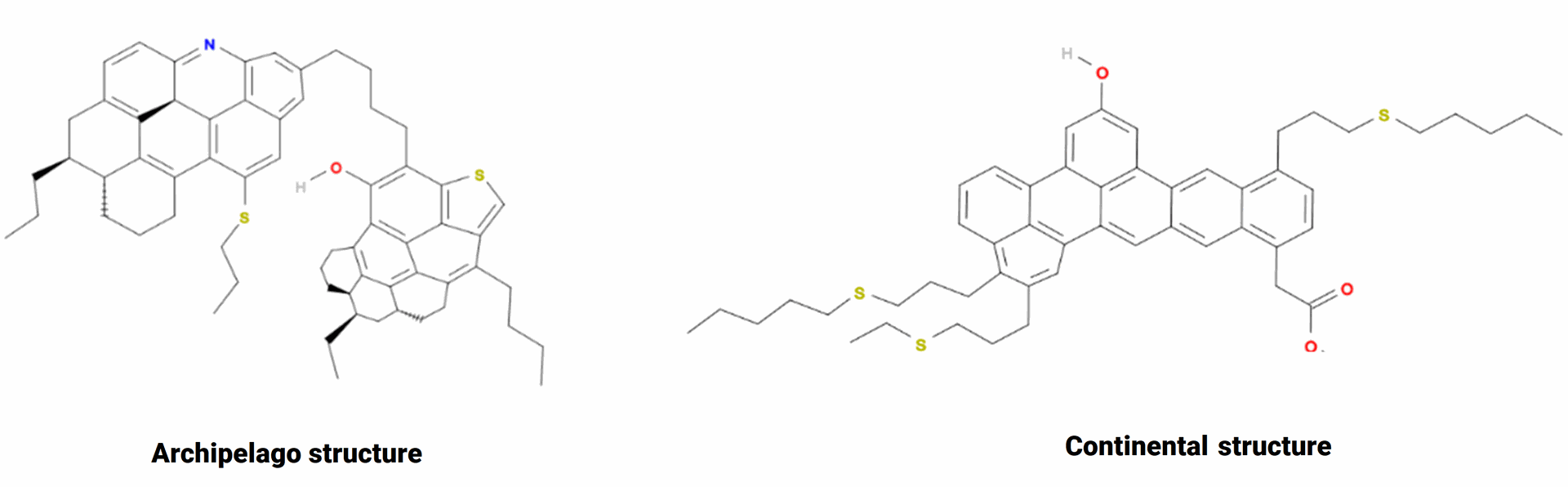
Fig. 2 : Asphaltenes structures : Archipelago (left) Continental structure (right) source (
Ahmadi, M.; Chen, Z.
Symmetry 2020, 12, 1767. https://doi.org/10.3390/sym12111767
)
These structural elements are assembled into a variety of functional groups, including polyaromatic, phenolic, pyrrolic, pyridinic, carboxylic, sulfide, hydroxyl, and ketonic groups. Such functional groups can be broadly classified as acidic, basic, amphoteric, or neutral, and they strongly influence asphaltene behavior and interactions with oil, water, rock surfaces, and treatment chemicals.
As a result, asphaltene fractions are not uniform. Some are rich in acidic functionalities, others in basic ones, and this compositional variability directly affects their stability, aggregation tendency, and response to chemical treatments.
Variability of Asphaltenes
Asphaltene composition varies with the carbonaceous source. For example, petroleum-derived asphaltenes differ significantly from coal-derived asphaltenes. Even more intriguingly, asphaltenes obtained from the same crude oil can exhibit different properties depending on the method used for their extraction.
Pentane-induced asphaltenes differ from CO₂-induced asphaltenes, and both differ from asphaltenes formed due to pressure depletion or depressurization. Furthermore, asphaltenes precipitated using different alkanes display distinct characteristics, as shown in Fig. 3. This is why asphaltenes are often designated by the solvent used for their extraction: C₅ asphaltenes (pentane), C₇ asphaltenes (heptane), and so forth.
Given these observations, it is not surprising that laboratory-generated asphaltene deposits often differ from field-formed deposits, a discrepancy that has been widely reported in the literature.
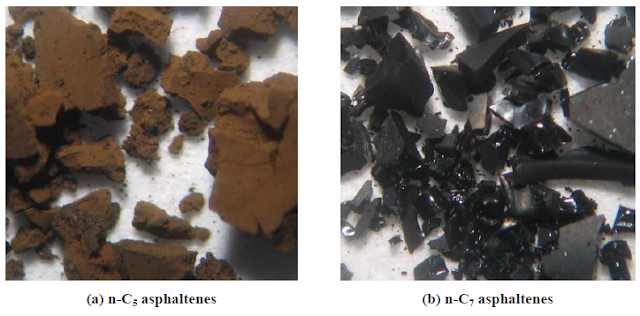
Fig.3: Examples of appearance of asphaltenes separated from the same crude oil with different alkane precipitant , n-heptane (right) , n-pentane(left) source ( NMT ASPHALTENE FAQ , New Mexico Tech. n.d., What are asphaltenes?. Petroleum Recovery Research Center )
Challenges in Asphaltene Characterization
By now, it should be clear why asphaltenes are often described as confusing fraction of crude oil. Their complex composition, coupled with variable extraction yields and methods, leads to significant differences in observed behavior. Asphaltenes can behave differently in aqueous systems compared to organic solvents, and even within organic solvents, their behavior may vary with dilution.
Consequently, the literature contains conflicting reports on fundamental asphaltene properties such as molecular weight, charge, and aggregation state. This inconsistency is further compounded by the wide range of analytical techniques used to study asphaltenes and other heavy fractions, including mass spectrometry, electron microscopy, nuclear magnetic resonance, small-angle neutron and X-ray scattering, ultrasonic spectroscopy, dynamic light scattering, fluorescence-based methods, vapor-pressure osmometry, and gel permeation chromatography. Different techniques inevitably yield different perspectives and results.
The Yen–Mullins Model
According to the modern interpretation of asphaltene behavior, as described by the Yen–Mullins model, asphaltenes exist in crude oil and solvents in three hierarchical forms: individual molecules, nanoaggregates, and clusters of nanoaggregates (Fig. 4).
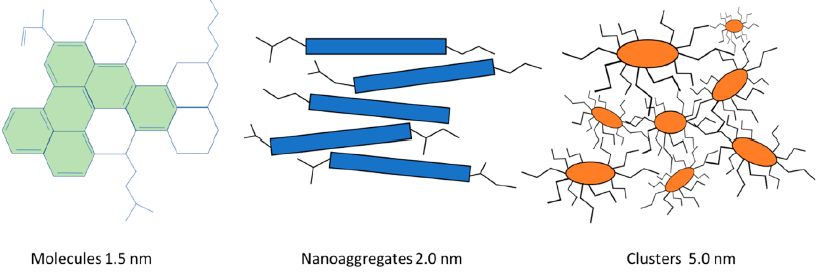
Fig.4: Yen−Mullins model, the model shows the dominant molecular and colloidal structures for asphaltenes in laboratory solvents and
crude oils. (source : Boczkaj et al. Ind. Eng. Chem. Res. 2023, 62, 2−15 https://doi.org/10.1021/acs.iecr.2c02532)
Stability and Precipitation Mechanisms
Asphaltene stability and precipitation mechanisms have been studied extensively over several decades. Two primary theoretical frameworks are commonly cited:
-
Colloidal Models:
In these models, asphaltenes are stabilized by resins adsorbed on their surface. Disruption of the asphaltene–resin balance leads to precipitation. Within this framework, asphaltene precipitation is considered largely irreversible (Fig. 5). -
Solubility Models:
Here, asphaltenes are treated as a solute dissolved in crude oil. Precipitation is described using liquid–liquid or solid–liquid equilibrium concepts and is considered a reversible, thermodynamic process.
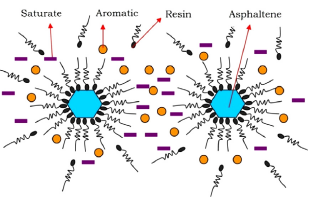 Fig.5: The colloidal model (source: Ashoori et al. 2017 Egyptian Journal of Petroleum Volume 26, Issue 1, March 2017, Pages 209-213)
When production conditions change, asphaltenes may destabilize, aggregate, and progress through a hierarchical precipitation pathway—from individual molecules to fully aged, solid deposits (Fig. 6).
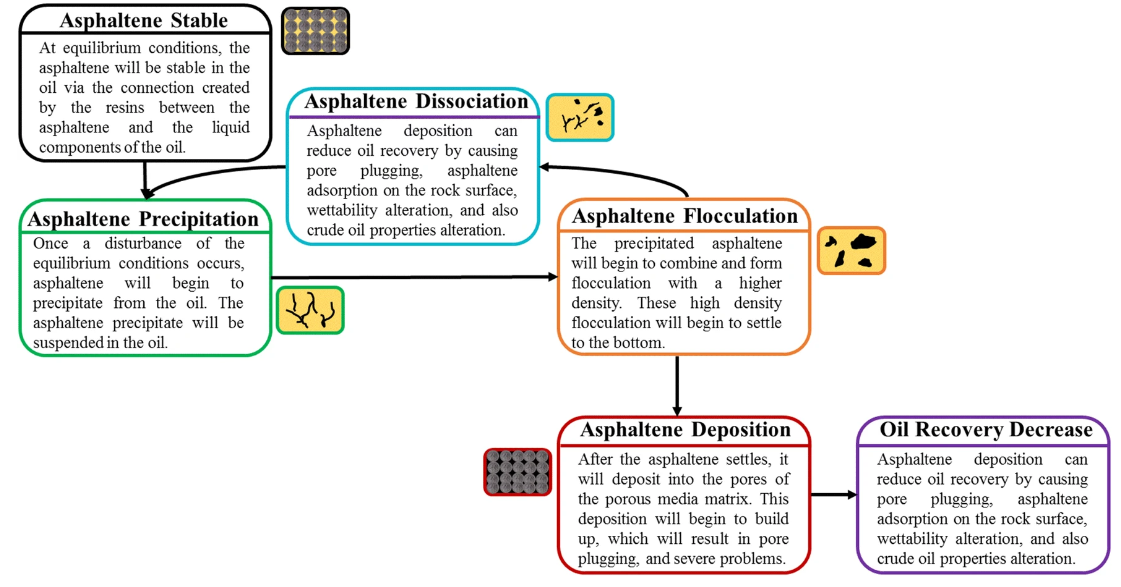 Fig.6: Asphaltene life cycle (source:
Fakher et al 2020,J Petrol Explor Prod Technol 10, 1183–1200 (2020). https://doi.org/10.1007/s13202-019-00811-5)
Fig.6: Asphaltene life cycle (source:
Fakher et al 2020,J Petrol Explor Prod Technol 10, 1183–1200 (2020). https://doi.org/10.1007/s13202-019-00811-5)
What Triggers Asphaltene Deposition?
This leads to the central question: what causes asphaltenes to aggregate and deposit?
The short answer is: almost everything. This is not an exaggeration but a reflection of the extreme sensitivity of asphaltenes to changes in system conditions, which is precisely what makes them such a persistent flow assurance challenge.
Key factors influencing asphaltene precipitation include:
- Pressure depletion, particularly near the bubble point
- Temperature variations
- pH changes
- Mixing incompatible crude oils
- Addition of alkanes or incompatible solvents
- High concentrations of metal ions
- Corrosion processes
- Acidizing and acid-cleaning operations
- CO₂ injection
- Gas lift operations
- Hydrodynamic effects and shear
- Streaming potential and electrokinetic effects
Therefore, effective management of asphaltene-related problems requires a comprehensive, system-wide analysis to identify the true root causes of destabilization. Without such an integrated approach, mitigation strategies may be ineffective or even counterproductive.
Further reading and resources:
- Flow assurance solids in oil and gas fields
- Hussein (2023), Essentials of Flow Assurance Solids in Oil and Gas Operations, Elsevier.