28 December 2023| By Abdullah Hussein
Wax gelation and deposition remain major flow assurance challenges in oil and gas production systems. Wax precipitation begins once the crude oil temperature falls below the wax appearance temperature (WAT). This triggers several operational issues, including changes in crude oil rheology and flowability, equipment damage, and pipeline blockages. These issues often result in costly maintenance, unplanned shutdowns, and significant production losses.
Wax problems are commonly mitigated using several chemical types, such as wax inhibitors (WI or PI), pour-point depressants (PPD), and wax dispersants (WD or PD) (Fig. 1).
 Fig.1: Wax control chemicals
The performance of these chemicals is typically assessed through laboratory tests, including:
- WAT measurement
- Pour point (PP) determination
- Viscosity profiling
- Cold finger (CF) testing
- Flow loop testing
Although these test methods are well established and widely used, discrepancies sometimes occur between laboratory performance and field results. A chemical that appears highly effective in lab conditions may fail to achieve the expected performance in actual operations. These inconsistencies can arise from multiple factors associated with testing conditions, chemical design, fluid properties, or their interactions. A brief overview of these factors is provided below.
1. Treating Chemical Composition
Wax control chemicals are generally formulated with bulky functional groups and long side chains. The side chains co-crystallize with wax molecules, while the bulky polar groups impose steric hindrance, disrupting the wax network. Key parameters that influence chemical performance include:
- Side-chain length
Optimal performance typically requires matching the side-chain length of the treatment chemical with the carbon distribution of field wax deposits. Accurate characterization of the field deposits is therefore critical.
- Number and spacing of bulky/polar groups
These groups influence co-crystallization behavior and solubility in both crude oil and the carrier solvent. Excessively bulky structures may impair solubility, reducing field performance despite good laboratory results.
- Molecular weight
Very high molecular weight polymers may exhibit solubility challenges in crude oil and solvents. Such chemicals can perform well under controlled lab conditions but fail in the field due to miscibility issues. High molecular weight also increases the risk of plugging small-diameter injection lines or forming deposits at the injection point.
2. Fluids Composition
- Wax type and crude oil characteristics
Wax chemicals tend to perform better with crudes rich in cyclic and branched alkanes, which create a poorly packed wax network. Conversely, crudes containing significant amounts of heavy wax molecules (>C40) are more challenging due to limited carbon-number matching possibilities.
- Asphaltene content and behavior
Asphaltenes significantly influence wax deposition dynamics. They can either suppress or enhance wax deposition rates, directly affecting the required chemical dose and performance. Asphaltenes may also consume or interact with injected chemicals, reducing the effective concentration available for wax control.
For example, comb polymers—commonly used as PPDs—can interact with asphaltenes and stabilize them (Fig. 2). Such interactions may compete with wax modification mechanisms, especially if asphaltenes behave differently in field conditions compared to laboratory testing. Some studies also suggest asphaltenes can enhance WI performance under specific conditions.
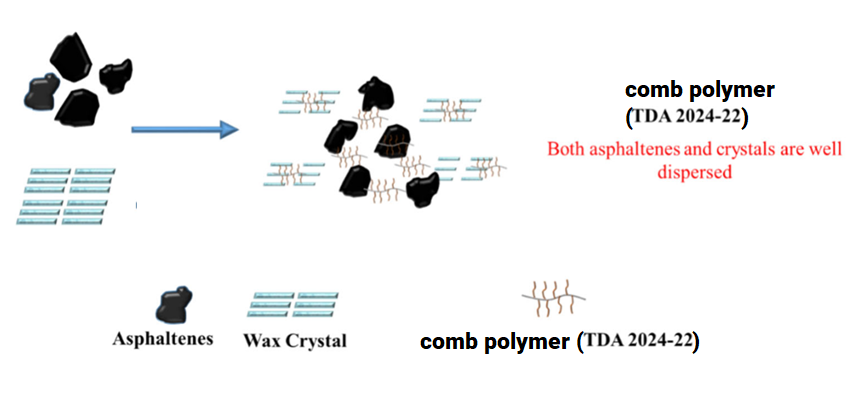 Fig.2: Wax and asphaltene interactions with comb like polymers (Adapted from:
Li et al. Energies. 2021; 14(24):8243. https://doi.org/10.3390/en14248243 )
Fig.2: Wax and asphaltene interactions with comb like polymers (Adapted from:
Li et al. Energies. 2021; 14(24):8243. https://doi.org/10.3390/en14248243 )
- Fluids compatibility
Mixing incompatible crudes can destabilize asphaltenes, increasing wax deposition and altering chemical response. Incompatibility with other injected chemicals further complicates treatment design. Mixing crudes already treated with different chemical packages requires thorough compatibility screening.
- Water cut
Most wax-control tests are performed on dehydrated crude. However, the presence of water may alter wax deposition rates and modify asphaltene behavior, which in turn affects chemical performance.
3. Operational Conditions
• Thermal history
Heating and cooling cycles significantly influence WAT, PP, and crude rheology. Chemical selection and dosing strategies should account for the full thermal history of the crude oil entering the system.
• Flow dynamics and process conditions
Certain PPDs are sensitive to shear rates, cooling rates, and fluid residence time. These factors must be evaluated when extrapolating lab results to field environments.
- Injection strategy
Key considerations include:
- Solvent selection: The solvent must fully dissolve the chemical, be compatible with produced fluids, and must not destabilize asphaltenes.
- Injection location: Chemicals should be injected upstream of the WAT (typically 10–15°C above) to prevent initial wax crystal formation. This requires understanding the system’s temperature profile.
- Dose control: Maintaining consistent dosage is essential for sustained performance.
- Hydrodynamics across the system
A chemical may perform well in upstream high-turbulence areas where mixing is efficient, but its effectiveness may diminish downstream in long pipelines where fluid velocity decreases. Reduced turbulence promotes wax dropout once the chemical is depleted. In such cases, section-wise treatment may be required—for example, injecting an inhibitor upstream and a dispersant further downstream.
- Multiphase flow effects
The extent and nature of multiphase flow (e.g., slug flow, stratified flow, annular flow) influence mixing efficiency, wax deposition location, and chemical effectiveness.
Further Reading:
- Hussein (2023), Essentials of Flow Assurance Solids in Oil and Gas Operations, Elsevier.